Why such a Dark Universe? We are in the best place to view the complete history of the universe.
Dark Moon, small as can be, yet large enough to support advanced life.
Dark Solar System (No near by large gas or dust clouds)
Distant Star Clusters (one star 4 light-years (ly) away, next star is 35 ly away, closest clusters 150 ly away)
Dark Nebulae (closest Nebula is 650 ly away)
Dark Galaxy Clusters (closest Galaxy is 2.5 million ly away)
Dark Matter (Milky Way Dark Matter is 3,260 light-years from the Sun, stabilizing the spiral arms for life, and can not be seen)
Dark Energy (In the spacetime curvature of the universe and throughout all of space and can not be seen)
Job 38:19–20. “Where does darkness reside?…Do you know the paths to their dwellings?" Over 4,000 years ago, God asked this question; not until recently did we know the answer. (Dark Matter and Dark Energy)
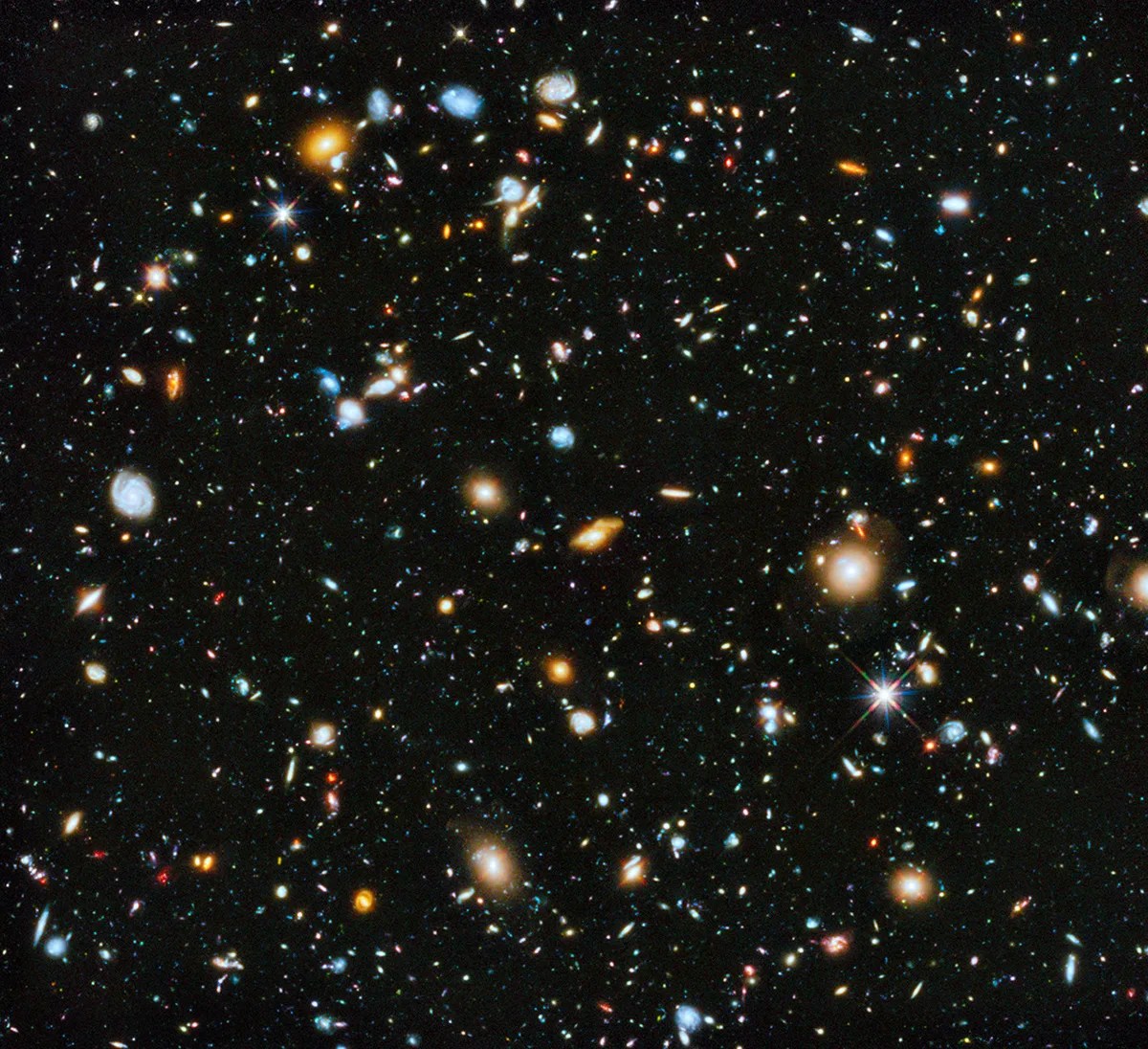
As light travels at 186,000 miles per second, thus as astronomers look at the night sky they see only the past, as light takes time to travel. Astronomers can see back in time 13.7 billion years. The earliest color photo of the universe is the Hubble Ultra Deep Field, taken as it was 3.8 billion years ago. This is only possible in a very dark place in the universe, which the Earth is. Ext Link: NASA Hubble Ultra Deep Field Photo. To NASA Hubble Deep Field website.
The Right Stuff - Mass of the universe:
Ordinary matter 4.62% – Stuff we can see (Stars 0.27% and Planets 0.0001%)
Dark matter 23.3% – Cannot see, but measured gravitational. One key to the Milky Way's stable Arms, a key to life on Earth.
Dark energy 72% - in the spacetime curvature of the universe and throughout all of space, causing the universe to expand faster. The expansion rate is highly fine-tuned for life on Earth or anywhere in the universe.
__________________
Psalm 19:1-3 “The heavens declare the glory of God; the skies proclaim the work of his hands. Day after day they pour forth speech; night after night they reveal knowledge. They have no speech, they use no words; no sound is heard from them. Yet their voice goes out into all the earth, their words to the ends of the world.”
____________________________
Early Dark Sky on Earth
Gen 1:1 "In the beginning God created the heavens and the earth. 2 Now the earth was formless and empty, darkness was over the surface of the deep, and the Spirit of God was hovering over the waters."
Job 38:9, “I [God] made the clouds its [Earth’s seas] garment and wrapped it in thick darkness.”
The Bible states in Gen 1 and Job 38:9 that the early earth had a dark sky, thus the sun (made in Gen 1:1) was not visible on the surface of the earth (over the water, ocean).
Six geochemists led by Paolo Sossi demonstrated that outgassing from this magma ocean produced an atmosphere identical to Venus, very dark. The lack of oxygen in Earth’s atmosphere also made it hazy and dark.
Genesis 1:14 “Let there be lights in the expanse of the heavens. . . . they shall serve as signs and for seasons, and for days and years.”
As Genesis 1:20 implies, the signs are for the benefit of the animals created after Earth’s atmosphere became transparent, due to higher oxygen levels. The phrase "Let there be light" does not have the word create or made in it. Often, those who hate the God of the Bible will change the wording and replace "Let there be lights" with God created the sun.
_____________
Also See Space-Time page
Also See Why so Vast
____________
Ref:
Stacy S. McGaugh et al., “The Baryon Content of Cosmic Structures,” Astrophysical Journal Letters 708 (January 1, 2010): L14–L17.
Eichiro Komatsu et al., “Five-Year Wilkinson Microwave Anisotropy Probe Observations: Cosmological Interpretation,” Astrophysical Journal Supplement 180 (February 2009): 330–76.
Yungui Gong, Xiao-Ming Zhu, and Zong-Hong Zhu, “Current Cosmological Constraints on the Curvature, Dark Energy and Modified Gravity,” Monthly Notices of the Royal Astronomical Society 415 (August 2011): 1943–49.
Olga Sergijenko, Ruth Durrer, and Bohdan Novosyadlyj, “Observational Constraints on Scalar Field Models of Dark Energy with Barotropic Equation of State,” Journal of Cosmology and Astroparticle Physics 8 (August 20, 2011): pp. 004.
M. Sullivan et al., “SNLS3: Constraints on Dark Energy Combining the Supernova Legacy Survey Three-Year Data with Other Probes,” Astrophysical Journal 737 (August 2011): id. 102.
Marek Biesiada, Beata Malec, and Aleksandra Piórkowska, “Dark Energy Constraints from Joint Analysis of Standard Rulers and Standard Candles,” Research in Astronomy and Astrophysics 11 (June 2011): 641–54.
Yun Chen and Bharat Ratra, “Galaxy Cluster Angular Size Data Constraints on Dark Energy,” (May 2011): eprint arXiv:1105.5660.
E. Komatsu et al., “Seven-Year Wilkinson Microwave Anisotropy Probe (WMAP) Observations: Cosmological Interpretation,” Astrophysical Journal Supplement 192 (February 2011): id. 18.
T. Schrabback et al., “Evidence for the Accelerated Expansion of the Universe from Weak Lensing Tomography with COSMOS,” Astronomy and Astrophysics 516 (June–July 2010): id. A63.
P. Teerikorpi and A. D. Chernin, “The Hubble Diagram for a System within Dark Energy: The Location of the Zero-Gravity Radius and the Global Hubble Rate,” Astronomy and Astrophysics 516 (June–July 2010): id. A93.
Vicent J. Martínez et al., “Reliability of the Detection of the Baryon Acoustic Peak,” Astrophysical Journal Letters 696 (May 1, 2009): L93–L97.
M. Kowalski et al., “Improved Cosmological Constraints from New, Old, and Combined Supernova Datasets,” Astrophysical Journal 686 (October 20, 2008): 749–78.
Tommaso Giannantonio et al., “Combined Analysis of the Integrated Sachs-Wolfe Effect and Cosmological Implications,” Physical Review D 77 (June 2008): id. 123520.
John P. Blakeslee et al., “Discovery of Two Distant Type Ia Supernovae in the Hubble Deep Field-North with the Advanced Camera for Surveys,” Astrophysical Journal 589 (2003): 693–703.
Ryan Scranton et al., “Detection of Cosmic Magnification with the Sloan Digital Sky Survey,” Astrophysical Journal 633 (November 2005): 589–602.
Daniel J. Eisenstein et al., “Detection of the Baryon Acoustic Peak in the Large-Scale Correlation Function of SDSS Luminous Red Galaxies,” Astrophysical Journal 633 (November 2005): 560–74.
Dark Sky:
Paolo A. Sossi et al., “Redox State of Earth’s Magma Ocean and Its Venus-Like Early Atmosphere,” Science Advances 6, no. 48 (November 25, 2020): id. eabd1387, doi:10.1126/sciadv.abd1387.
Kevin Zahnle, Laura Schaefer, and Bruce Fegley, “Earth’s Earliest Atmospheres,” Cold Spring Harbor Perspectives in Biology 2, no. 10 (October 2010): id. a004895, doi:10.1101/cshperspect.004895; Kevin Zahnle et al., “Emergence of a Habitable Planet,” Space Science Reviews 129 (August 2007): 35–78, doi:10.1007/s11214-007-9225-z.
Hilke E. Schlitchting, Paul H. Warren, and Qing-Zhu Yin, “The Last Stages of Terrestrial Planet Formation: Dynamical Friction and the Late Veneer,” Astrophysical Journal 752, no. 8 (June 10, 2012): id. 8, doi:10.1088/0004-637X/752/1/8; R. Brasser et al., “Late Veneer and Late Accretion to the Terrestrial Planets,” Earth and Planetary Science Letters 455 (December 1, 2016): 85–93, doi:10.1016/j.epsl.2016.09.013.
god-and-nature.org Home Topics: Bible Faith Nature Biology History Cults World Religions News-N-Bible Links About
Founded 2026 - Facebook TBA and x.com @godandnature56
Why is there something? Why not nothing?